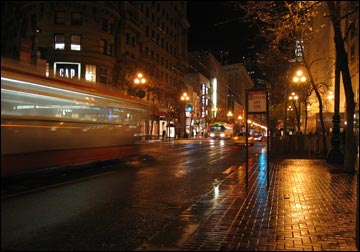
When you take a photograph with your camera, two important things happen: the
aperture snaps down to your chosen size, and the shutter clicks open for exactly as long
as you told it to. All in the blink of an eye! Both the aperture and shutter speed limit the
light that comes into the camera. The combination of the two is what's called an
"exposure": exposing the digital sensor (or film) to just the right amount of light to make
the photograph appear not too light and not too dark.
Most cameras have built-in "light meters" that suggest
appropriate exposures based on the brightness of the scene.
Exposures values are measured in stops (like apertures and
shutter speeds) relative to the suggested exposure. By
reading your light meter (look through the viewfinder) you
can tell if the photograph you're about to make will be too
bright (+), too dark (-), or just right. You can then make
adjustments to the aperture or shutter speed if you want to.
You can get the same exposure by using different aperture
and shutter speed combinations. If you want the same
results, you'll have to speed up or slow down the shutter
speed by the same number of stops you widen or narrow the aperture by (and vice versa).
Remember the effects that different apertures and shutter speeds will produce!
For example, all three of these aperture / shutter speed
combinations produce the same final exposure. There
are lots of other combinations too – you're only limited
by the range of your camera and lens! Try finding the
suggested exposure for a certain subject through your
camera's viewfinder. Change either the shutter speed
or the aperture, then think about how to adjust the other
to bring the exposure back to where you started.
Exposure Fact #1
Your camera's light meter will change its suggested exposure based on the ISO
setting of your digital sensor (or film). The ISO setting changes the sensor's
sensitivity to light, and is commonly set to 100, 200, 400, 800, or 1600. As usual,
each higher ISO is one stop "faster" than the last, and requires half as much light
to obtain the same exposure. For example, if your camera's light meter suggested
"1/60s at f8" for ISO 100, it might suggest "1/125s at f8", or "1/60s at f11" for
ISO 200.
Exposure Fact #2
Your camera's light meter will suggest an exposure that makes your photograph
"18% gray" – the optimum exposure to show the most detail. If you want the
photograph to look brighter or darker, you'll have to change either the shutter
speed or aperture. For example, if you were taking a photograph of a bright white
picket fence, you might have to overexpose (brighten) the photograph. You can do this either by slowing down the shutter speed or opening up the aperture,
probably by about 1 or 2 stops.

This comment has been removed by the author.
ReplyDelete